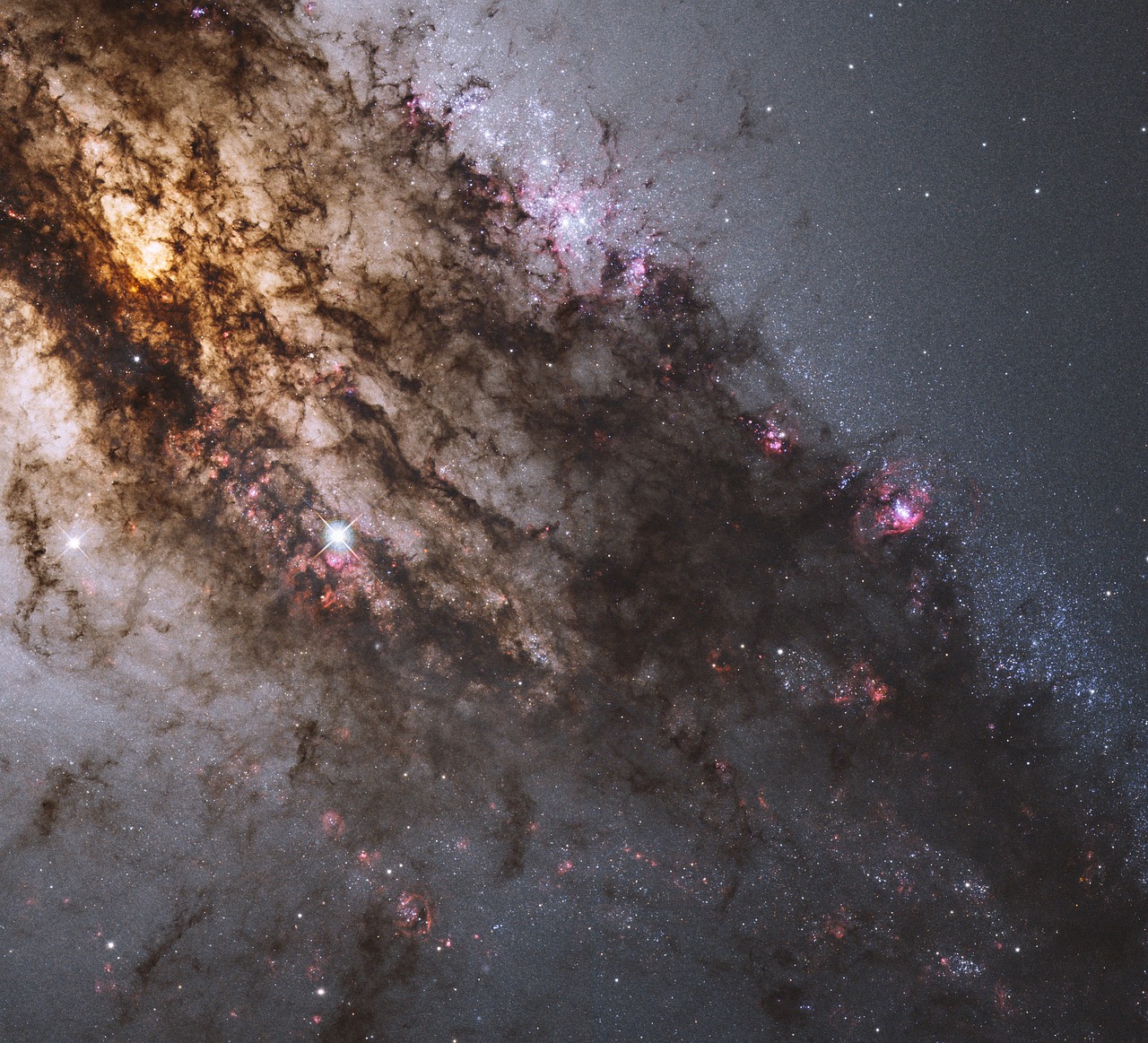
NASA has released the most detailed images ever captured of Centaurus A, a nearby active galaxy, marking the fourth anniversary of the James Webb Space Telescope’s first scientific images. The new observations showcase the Webb telescope’s unrivaled ability to peer through dense cosmic dust and reveal the hidden mechanics of galaxy evolution.

Centaurus A as seen by the James Webb Space Telescope’s MIRI and NIRCam instruments. Credit: NASA, ESA, CSA, STScI
A Galaxy Unlike Its Neighbors
Located approximately 11 million light-years from Earth, Centaurus A stands out from other nearby galaxies due to its extraordinary level of activity. At its heart lies a supermassive black hole that is actively feeding on surrounding material, releasing enormous amounts of energy in the process. The galaxy’s chaotic, distorted structure is the result of a major collision with another galaxy that occurred roughly 2 billion years ago, making it a perfect natural laboratory for understanding how galaxies and their central black holes co-evolve.
Seeing Through the Dust
Prior to Webb, astronomers faced significant challenges studying Centaurus A. The Hubble Space Telescope’s visible-light observations were largely blocked by the thick layers of dust that shroud the galaxy. While NASA’s Spitzer Space Telescope managed to capture the galaxy’s large-scale structures in infrared light, it lacked the resolution to distinguish individual stars within the dust clouds.
Webb’s Mid-Infrared Instrument (MIRI) has now changed that entirely. By observing at mid-infrared wavelengths, MIRI can pierce through the dust to reveal intricate details of the galaxy’s rich dust structures. The glowing reddish-purplish dots visible in the new images represent dust-rich stars and stellar nurseries — regions where old stars are shedding material and new stars are being born.
A Combined View
Alongside the MIRI image, NASA also released a composite view combining data from MIRI and Webb’s Near-Infrared Camera (NIRCam). This multi-wavelength approach gives scientists an unprecedented comprehensive view of the galaxy.
“These images mark four years of better-than-anticipated performance and successful science operations for the most powerful space telescope in history,” NASA wrote in its announcement.
What’s Next
With the resolution Webb provides, scientists can now study Centaurus A star by star, gathering the data needed to construct a detailed timeline of the galaxy’s evolution. The observations demonstrate once again why the James Webb Space Telescope — now entering its fifth year of science operations — remains the most powerful observatory ever deployed, continuing to transform our understanding of the cosmos one image at a time.