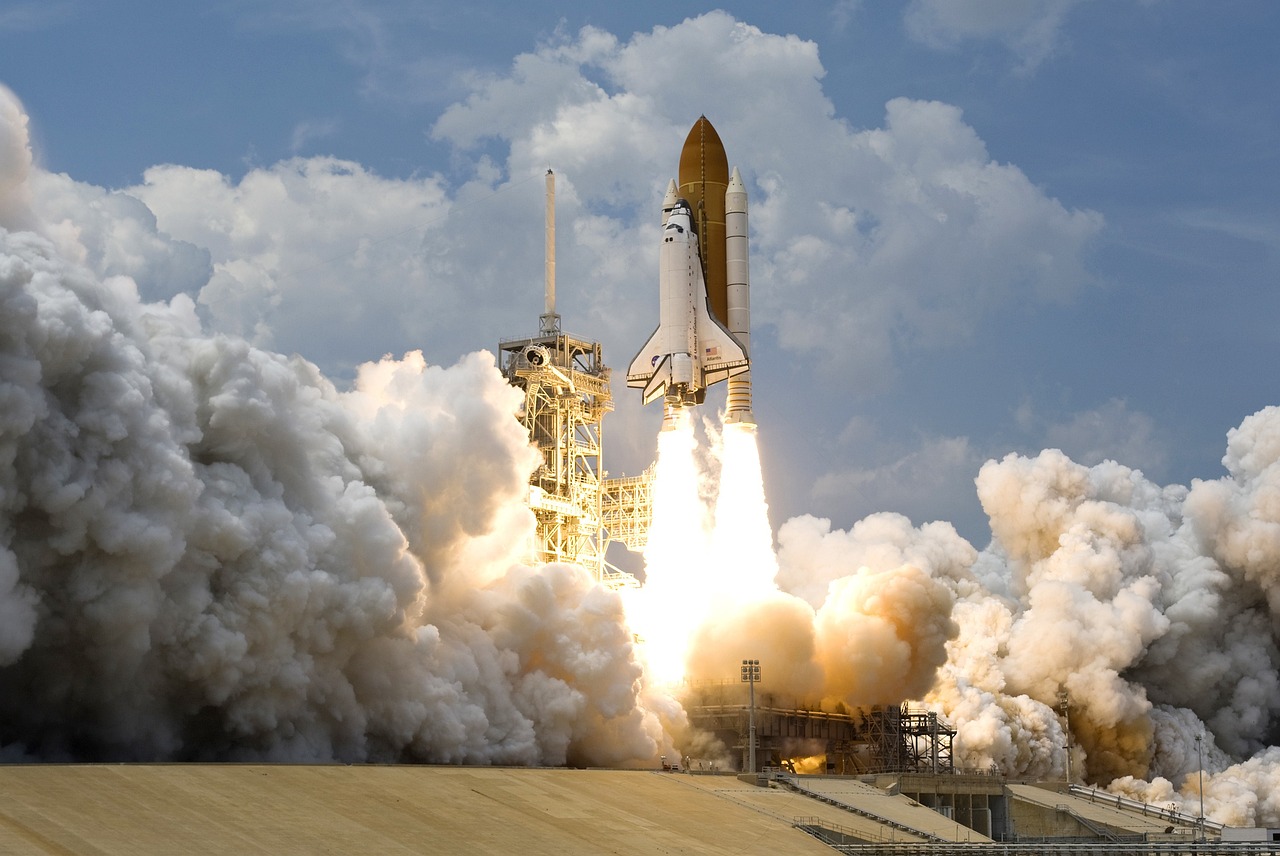
NASA’s Swift Boost mission successfully launched from the Marshall Islands on July 3, 2026, kicking off a high-stakes operation to rescue the Neil Gehrels Swift Observatory — a space telescope whose orbit has been decaying faster than anticipated due to increased solar activity.
The mission is unusual from the ground up. The rescue spacecraft, named LINK, was attached to a Northrop Grumman Pegasus XL rocket, which was itself strapped to the belly of a carrier plane called Stargazer. Taking off from the Kwajalein Atoll in the Marshall Islands, Stargazer climbed to an altitude of approximately 40,000 feet before releasing the rocket. After a brief free fall, the Pegasus XL’s engines ignited and delivered LINK into orbit.
First Contact Established
Ground teams have already made contact with LINK, achieving the mission’s first major objective. The spacecraft has powered on and will now undergo several weeks of health checks conducted by its builder, Arizona-based Katalyst Space Technologies. During this period, engineers will assess LINK’s propulsion, sensor, and navigation systems to ensure it is ready for the complex rendezvous ahead.
Once those checks are complete, LINK will begin its journey toward the Swift Observatory, surveying the telescope before making its approach.
How LINK Will Capture and Boost Swift
LINK is designed to physically capture the aging observatory using three robotic arms. After docking, it will slowly tug Swift to a higher orbit with an altitude of approximately 370 miles — a process expected to take between 10 and 12 weeks. The boost would extend the telescope’s operational life by a decade or more.
The intervention is urgently needed. While all satellites eventually lose altitude due to atmospheric drag, recent solar activity has significantly accelerated Swift’s orbital decay. Without LINK’s help, the telescope would plunge through the atmosphere and burn up by the end of 2026.
Why Swift Matters
The Neil Gehrels Swift Observatory has been one of NASA’s most productive astrophysics missions since its launch in 2004. For over two decades, it has studied gamma-ray bursts — the most energetic explosions in the universe.
“Gamma-ray bursts are short-lived flashes of high-energy light that release more energy in just a few seconds than the sun will in its entire lifetime,” said Brad Cenko, Swift’s principal investigator. Data from Swift has confirmed that the heaviest elements in the periodic table, including the gold and platinum in jewelry, are forged in these cataclysmic stellar explosions.
Beyond its original gamma-ray burst mission, Swift has evolved into what scientists call a “dispatcher” or “first responder” for sudden cosmic events, rapidly slewing to gather critical data whenever something unexpected lights up the sky.
A New Chapter for On-Orbit Servicing
The Swift Boost mission represents one of the most ambitious satellite rescue attempts ever undertaken. If successful, it will demonstrate that aging spacecraft without onboard propulsion or docking hardware can be intercepted, captured, and boosted to extended operational orbits. That capability could prove transformative for an industry that has traditionally treated satellites as disposable.
For now, NASA and Katalyst Space are focused on the weeks ahead: LINK’s health checks, the slow approach to Swift, and the delicate capture operation that will determine whether one of astronomy’s most valuable instruments gets a second life.